 |
| Domplatz, Speyer |
Thursday, January 23, 2014
New archives, new cities: the academic tourist

Tuesday, January 7, 2014
Work and play (or vice versa)

Wednesday, December 25, 2013
Frohe Weihnachten!
 |
| Wiesbaden's opera house |
Many of Germany's Christmas traditions (like trees!) have been exported, but the solemn festivities here remain very special, and celebrated for 3 days. Christmas Eve is Heiligabend, the holy evening, and then the 25th and 26th are observed as the first and second days of Christmas. I am taking full advantage of this! I started Christmas Eve by baking breakfast rolls (Rosinen-Quarkbrötchen,) after which I headed off to help serve an all-comers brunch with the parish of St. Augustine's, the Episcopal church which I've been attending here. Another Ph.D. candidate from the congregation invited me for a coffee afterwards, and we had a very nice and relaxed time in a café in central Wiesbaden. I came home to be almost literally pulled into the kitchen by my landlord's sister, who is a) visiting and b) very nice. So I joined her and my landlord for Christmas cookies and carol singing, with the recorders which they break out once a year (!). After all this, I felt that a bit of a rest was called for before late-night services… and Carols from King's was streaming via the BBC. This was actually my first Christmas in an Anglican service, as I've always traveled home for the holidays, so I was excited to get all the glorious liturgy. As, for example:
O God, who makest us glad by the yearly remembrance of the birth of thy only Son Jesus Christ: Grant that as we joyfully receive him for our Redeemer, so we may with sure confidence behold him when he shall come to be our Judge; who liveth and reigneth with thee and the Holy Ghost, one God, world without end. Amen
Saturday, December 21, 2013
On modern medicine
I spend a lot of time reading (and writing!) scholarly investigations of medieval medicine, pointing out the effectiveness of remedies tested by practice, and reminding non-specialists that it wasn't until the later nineteenth century that practices based on research into germ transmission started to be systematically implemented. The number of Completely Untrue Things written about medieval understandings of health, hygiene, and medicine are truly distressing. (For the record: many medieval cities had public bathhouses; water was not universally unsafe to drink; management of clean air and water was pursued at an individual and collective level.) But I digress. This specialist soapbox-standing is but a preamble to the observation that German druggists' and pharmacies still bear witness to much older and more diverse practices of maintaining and repairing health than U.S. drugstores. Shelves of herbal teas specially designed for a variety of minor ailments are here normative, not reserved (and priced) for niche health food stores. I've had more colds this winter than in any season I can remember, so have proved the effectiveness of "Bronchial health" tea, which advertised that its composition was based solely on experience and tradition, and lemon-herb cough suppressant tablets created in a monastery garden. And these are not just shelf remedies: the pharmacist at the Apotheke recently gave me ibuprofen for a fever, and for the sore throat that accompanied it, an oil of cloves, sage, fennel, and eucalyptus. With years of experience of self-selecting giant bottles of aspirin and syrupy compounds as potent as they are evil-tasting, I've found that these new customs take some getting used to. But I really do like them, on principle. The doctor to whom I turned in my need for antibiotics handed over her prescription with the advice "And drink lots of tea!" With both prescriptions, as you may imagine, I have enthusiastically complied. My planned spurt of pre-Christmas productivity was laid low, but fortunately, there are a number of old Heinz Rühmann movies on YouTube. And I have truly massive quantities of tea.
Sunday, December 8, 2013
Schöne Adventszeit
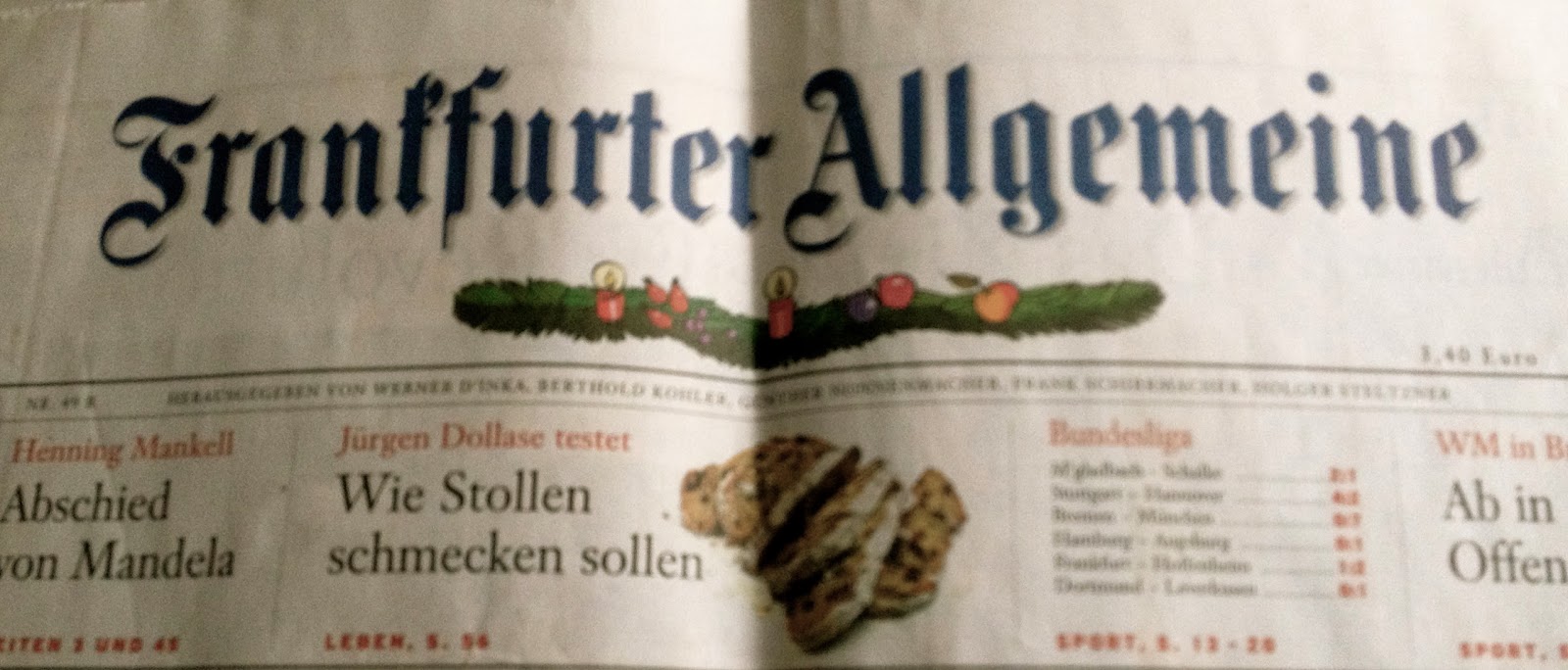
Above is the front page of this Sunday's edition of the FAZ (Frankfurter Allegemeine Zeitung.) That what is one of Germany's biggest and most prestigious papers features an Advent wreath and an article about exhaustive taste testing of Christmas cakes tells you that this season belongs on the long list of Things Germans Take Very Seriously. I absolutely love this. Train stations and shop windows are decked in fir garlands (and real fir garlands have appeared next to the fruits and vegetables on the weekly market.) As a member of a liturgical church tradition, I especially love that the observance of Advent, as a season separate from Christmas, is so culturally engrained over here. Acquaintances wish each other "eine schöne Adventszeit," "a good Advent-tide." A friend and I even got wished this by a sweet older lady whom we got to take this picture:

Wednesday, December 4, 2013
Further Adventures in the Archives
"Any presentation of a theme of Mainz's older history, including the history of the numerous monasteries and foundations of the city, of the archbishops and their ecclesiastical and secular activities and politics, is a difficult undertaking, if it is to be earnestly worked up from the sources. How troublesome it is, to have to work with such widely-scattered materials!" --Ludwig Falck, venerable historian of Mainz
On discovering the above complaint in one of Falck's many articles, I copied it out instantly. I may yet copy it out longhand and carry it from workspace to workspace as a sort of talisman, encouraging me with the reminder that challenges I face are not necessarily the result of a lack of experience or intelligent judgment on my part. For indeed, Mainz's archival holdings are unusually scattered and depleted, despite the city's well-attested medieval prosperity. (An advantage to this is that, while Mainz was super-important in the Middle Ages, it hasn't been studied as much as most cities of comparable or even inferior size and influence. This makes a great line when pitching my project to funding committees.) Many of the depletions I knew about before coming here; some came as a surprise. Early on, I protested. "But I did consult printed articles on the archives, and the reference work with lists of all your holdings!" I lamented to one of the diocesan archivists. "That's as may be," he answered, "but unfortunately, you have made an entirely false picture to yourself of what is here." Over the course of subsequent months, I have become more resigned… but this resignation (with which I imagine many, if not most medievalists are familiar) is anything but passive. Rather, I am finding that it requires both tenacity and scholarly imagination.
Saturday, November 30, 2013
Thanksgiving Française
 |
| Marseille and the Mediterranean… and the Chateau d'If! |
This past week, I took my nose away from the grindstone and took myself off to see a Fordham friend and colleague who's living in Marseilles. Being an American medievalist means mandatory travel in nearly all cases. This means coping with new challenges, academic and personal, without a social support system, of course… but also: living in Europe. It was my first time visiting France outside of Paris, my first time “en province,” as well as in Provence. The soil is different from that of my part of Germany; the building materials are different. (Parenthetically, I’m sure I wouldn’t be as conscious of this if 2 of the 3 weeks I spent tramping across northwestern Spain a few years ago hadn’t been alongside a professor who kept calling our attention to slate, to stone, to clay.) The countryside of Provence is the country of Marcel Pagnol, who managed to write tender and lyrical novels about how punishingly hard it can be to wring a living from the wind-weathered hills, as well as about the ecstasy of springtime there, and the unexpected enchantments of cultivated gardens. It’s also the territory which so often appears as “Countryside, near...” on museum plaques next to paintings by Cézanne.
Subscribe to:
Posts (Atom)